Introduction
Choosing the right LCD interface is one of the most important decisions when designing an industrial display system.
A TFT LCD module is not only selected by size, resolution, brightness, and viewing angle. The interface between the LCD module and the controller board directly affects:
Image quality
Data transmission speed
Power consumption
PCB design complexity
System reliability
Long-term product availability
Among Industrial TFT LCD Display, the most common interfaces are:
- LVDS (Low Voltage Differential Signaling)
- MIPI DSI (Mobile Industry Processor Interface)
- RGB Parallel Interface
Each interface has its own advantages and application scenarios.
This article explains the differences between LVDS, MIPI, and RGB interfaces and helps you choose the best LCD solution for your industrial application.
1. What Is an LCD Interface?
An LCD interface is the communication method between the main controller (CPU, MCU, FPGA, or processor board) and the TFT LCD module.
The interface transfers:
Image data
Synchronization signals
Clock signals
Control information
A suitable interface ensures stable communication between the system and the display.
Different applications require different interface solutions.
For example:
Application Recommended Interface Industrial HMI LVDS / RGB
Medical equipment LVDS / MIPI
Embedded devices MIPI
2. LVDS Interface: Stable and Reliable for Industrial Displays
What Is LVDS?
LVDS (Low Voltage Differential Signaling) is a high-speed differential transmission technology widely used in industrial TFT LCD modules.
Instead of transmitting data through single-ended signals, LVDS uses differential pairs to achieve:
High noise resistance
Lower electromagnetic interference (EMI)
Long-distance transmission capability
Advantages of LVDS LCD Displays
1. Excellent Stability
LVDS is widely adopted in industrial applications because of its high reliability.
It performs well in environments with:
Electrical noise
Long cable connections
Industrial equipment interference
2. Supports Medium and Large Size Displays
LVDS is commonly used for:
7 inch LCD
10.1 inch LCD
12.1 inch LCD
15 inch LCD
18.5 inch and larger displays
3. Mature Technology and Long Lifecycle
Many industrial LCD brands such as:
provide LVDS interface TFT LCD modules with long-term availability.
This makes LVDS a popular choice for industrial equipment manufacturers.
LVDS Applications
Typical applications include:
Industrial control panels
Medical devices
Factory automation equipment
Measurement instruments
Transportation systems
3. MIPI Interface: Compact and High-Speed Solution
What Is MIPI DSI?
MIPI DSI (Display Serial Interface) is a high-speed serial interface designed for modern embedded systems.
It is commonly used in:
Smartphones
Tablets
Embedded Linux devices
AI terminals
Advantages of MIPI LCD Displays
1. Lower Pin Count
Compared with RGB interfaces, MIPI requires fewer signal lines.
This helps:
Reduce PCB size
Simplify hardware design
Save connector space
2. Low Power Consumption
MIPI is designed for mobile applications and offers excellent power efficiency.
It is suitable for battery-powered devices.
3. High Resolution Support
MIPI can support:
HD displays
Full HD displays
High-resolution industrial displays
Limitations of MIPI
Although MIPI is becoming increasingly popular, it has some limitations.
Hardware Compatibility
The processor must support MIPI DSI.
Not all industrial controllers can directly connect to MIPI LCD modules.
More Complex Software Development
Compared with RGB, MIPI often requires more driver configuration.
MIPI Applications
Common applications:
Portable medical devices
Smart handheld equipment
Industrial tablets
Embedded systems
IoT devices
4. RGB Interface: Simple and Cost-Effective
What Is RGB Interface?
RGB interface is a parallel data transmission method.
The display receives:
Red data
Green data
Blue data
Horizontal synchronization signal
Vertical synchronization signal
Pixel clock
Advantages of RGB LCD Modules
1. Simple Design
RGB is easy to understand and widely supported by many MCUs and processors.
2. Lower Development Cost
For applications with standard requirements, RGB can reduce development complexity.
3. Suitable for Small and Medium Displays
Common RGB TFT LCD sizes:
3.5 inch
4.3 inch
5 inch
7 inch
Limitations of RGB
RGB requires many signal lines.
For higher resolution displays:
PCB routing becomes more complicated
Cable design becomes difficult
EMI performance may decrease
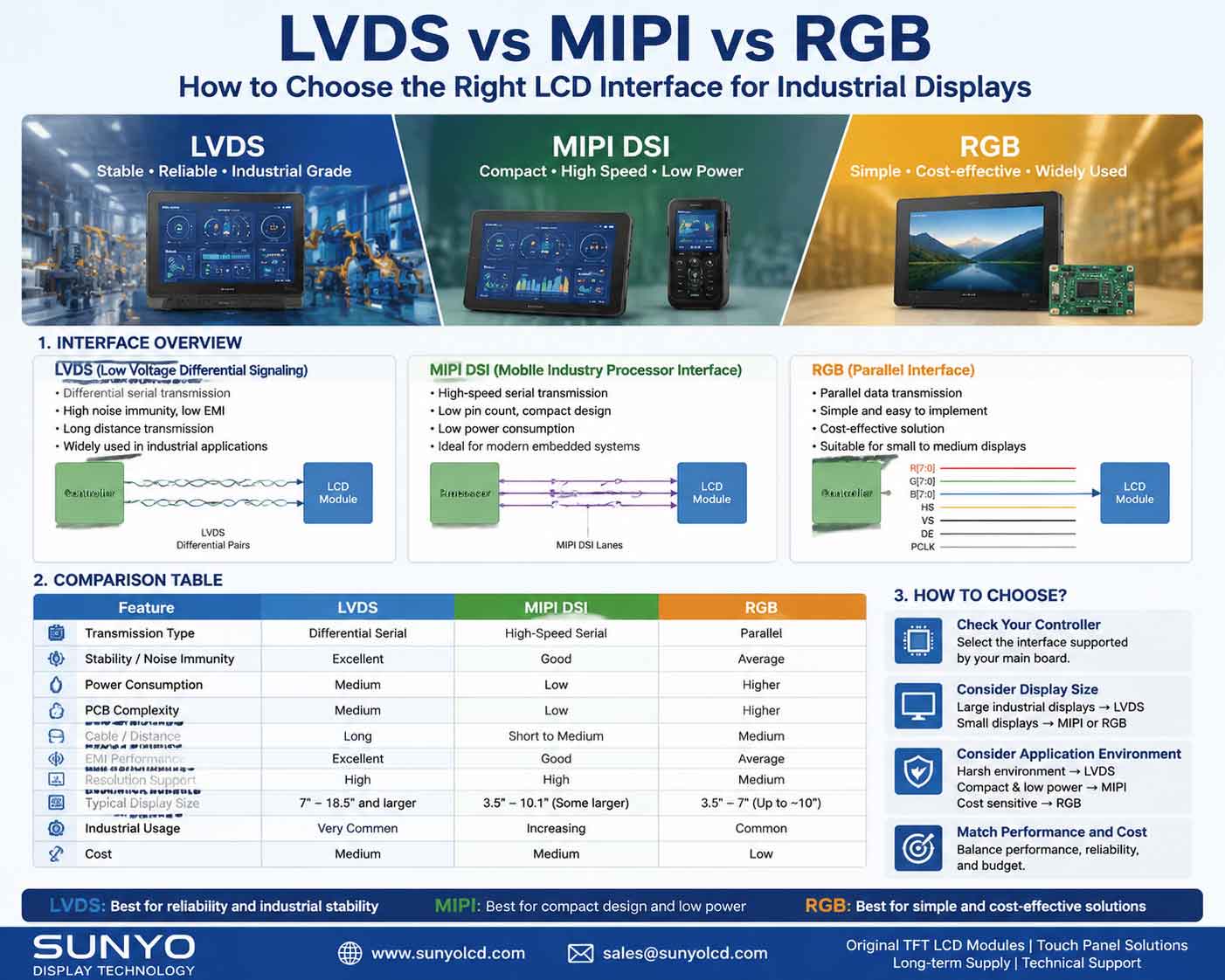
5. LVDS vs MIPI vs RGB Comparison
Feature LVDS MIPI RGB Transmission Differential serial High-speed serial Parallel Stability ⭐⭐⭐⭐⭐ ⭐⭐⭐⭐ ⭐⭐⭐ Power Consumption Medium Low Higher PCB Complexity Medium Low Higher Cable Distance Long Short Medium EMI Resistance Excellent Good Average Resolution Support High High Medium Industrial Usage Very Common Increasing Common Cost Medium Medium Low
6. How to Choose the Right LCD Interface?
When selecting an industrial TFT LCD module, consider these factors:
1. Check Your Controller Board
The first question:
Which interface does your main board support?
For example:
Raspberry Pi → MIPI / HDMI
Industrial motherboard → LVDS
MCU system → RGB
The LCD interface must match your hardware.
2. Consider Display Size
Generally:
Small Displays (3.5"–7")
Recommended:
RGB
MIPI
Medium Displays (7"–12.1")
Recommended:
LVDS
MIPI
Large Industrial Displays (12.1"+)
Recommended:
LVDS
eDP
3. Consider Application Environment
For harsh industrial environments:
Choose:
✅ LVDS
Because it provides:
Better noise resistance
Longer cable transmission
Higher reliability
For compact smart devices:
Choose:
✅ MIPI
Because it provides:
Smaller PCB design
Lower power consumption
7. Can LCD Interfaces Be Converted?
Yes.
Some projects use:
LVDS to HDMI converter
MIPI to LVDS converter
RGB to LVDS converter
However, converters increase:
Cost
Power consumption
Development complexity
The best solution is usually selecting a TFT LCD module with a native interface compatible with your controller.
8. Choosing a Reliable Industrial LCD Supplier
A professional LCD supplier should provide:
Original TFT LCD modules
Technical datasheets
Interface confirmation
Long-term supply support
Touch panel integration
Customized solutions
Sunyo provides industrial TFT LCD modules from leading brands including:
We support:
LVDS LCD modules
MIPI LCD modules
RGB LCD modules
Custom touch solutions
Conclusion
LVDS, MIPI, and RGB are all widely used LCD interfaces, but each one serves different purposes.
Choose LVDS when you need maximum reliability and industrial stability.
Choose MIPI when you need compact design and low power consumption.
Choose RGB when you need a simple and cost-effective display solution.
Selecting the correct LCD interface at the beginning of your project can reduce development time and improve product reliability.
Last News: How to Choose the Right Industrial TFT LCD Display for Your Application