When designing industrial equipment, choosing the right LCD display is a critical decision. Unlike consumer displays used in smartphones or televisions, industrial TFT LCD displays need to provide long-term reliability, stable performance, and excellent visibility under different working environments.
A suitable industrial LCD panel can significantly improve the user experience, reduce maintenance costs, and extend the lifetime of the final product.
This article explains the key factors engineers should consider when selecting an industrial TFT LCD display.
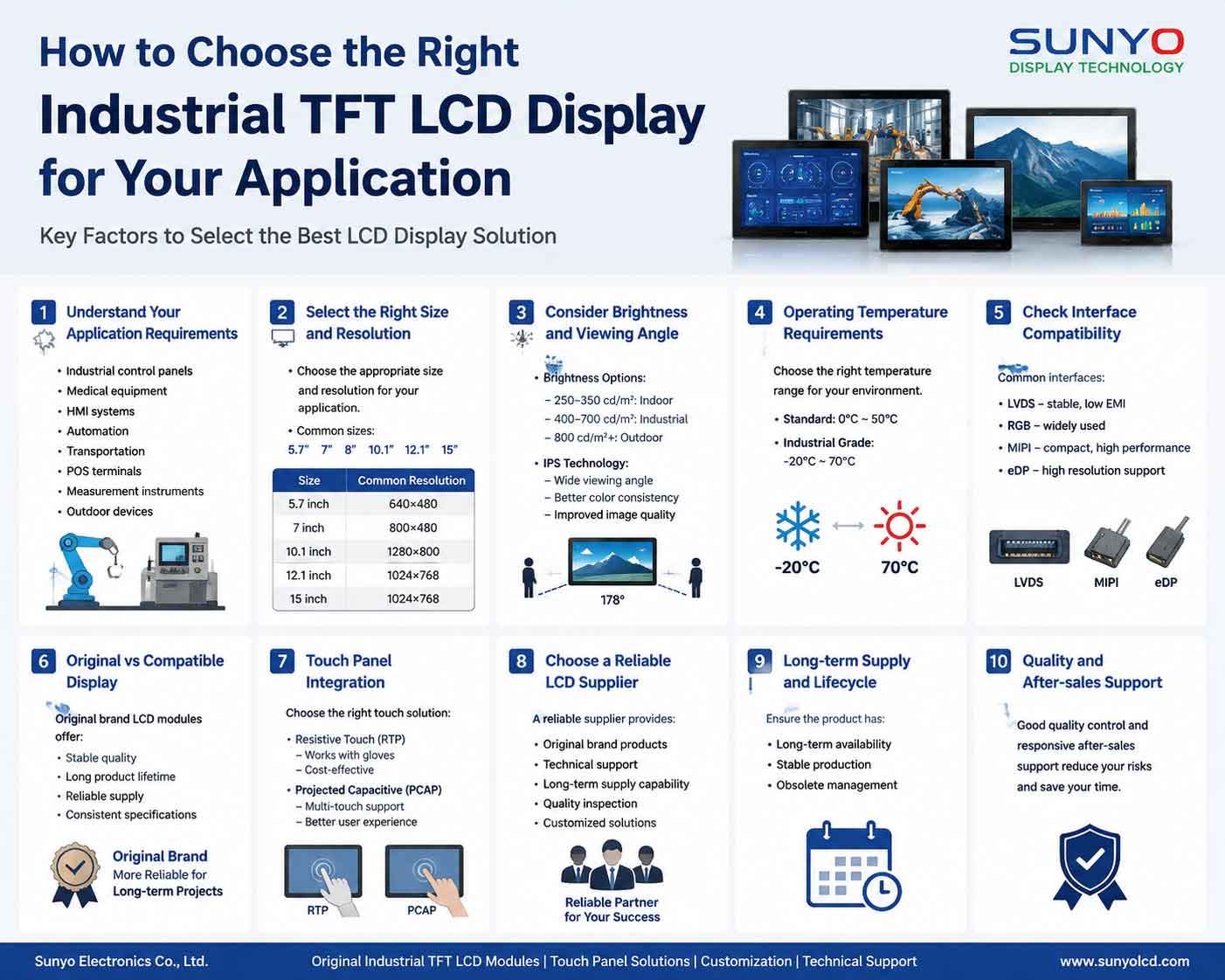
1. Understand Your Application Requirements
The first step is to understand where and how the display will be used.
Different applications require different display characteristics.
Common industrial LCD applications include:
Industrial control panels
Medical equipment
- HMI (Human Machine Interface)
Automation systems
Transportation equipment
POS terminals
Measurement instruments
Outdoor devices
For example:
A medical device may require:
High resolution
Wide viewing angle
Accurate color performance
Long-term stable supply
An outdoor industrial device may require:
High brightness
Wide operating temperature range
Strong sunlight readability
Therefore, selecting an LCD only based on size and resolution is not enough.
2. Select the Right LCD Size and Resolution
Industrial TFT LCD displays are available in many sizes, from small displays such as 2.4 inch and 3.5 inch to large displays above 15 inches.
Common industrial display sizes include:
5.7 inch
7 inch
8 inch
10.1 inch
12.1 inch
15 inch
The resolution should match the application requirements.
Examples:
Display Size Common Resolution 5.7 inch 640×480 7 inch 800×480 10.1 inch 1280×800 12.1 inch 1024×768 15 inch 1024×768
Higher resolution provides sharper images but may require more powerful hardware and higher cost.
3. Consider Brightness and Viewing Angle
Brightness is one of the most important parameters for industrial displays.
Typical brightness levels:
250–350 cd/m²: Indoor applications
400–700 cd/m²: Industrial environments
800 cd/m²+: Outdoor or sunlight-readable applications
For outdoor equipment, a standard LCD may become difficult to read because sunlight can wash out the display.
A high brightness industrial LCD with optimized polarizer technology can greatly improve readability.
Viewing angle is also important.
IPS technology usually provides:
Wider viewing angle
Better color consistency
Improved image quality
This is especially important for:
Medical equipment
Control rooms
Public information terminals
4. Operating Temperature Requirements
Industrial equipment often operates in harsh environments.
Unlike consumer LCDs, industrial TFT LCD modules usually support wider temperature ranges.
Common specifications:
Standard:
Operating temperature: 0°C ~ 50°C
Industrial grade:
Operating temperature: -20°C ~ 70°C
Wide temperature displays are suitable for:
Outdoor machines
Transportation systems
Industrial automation equipment
Choosing the correct temperature specification helps prevent display failure caused by environmental conditions.
5. Check Interface Compatibility
Before purchasing an LCD module, engineers should confirm the interface type.
Common LCD interfaces include:
LVDS
Widely used in industrial displays because of:
High speed
Stable transmission
Low electromagnetic interference
RGB
Common in smaller TFT displays.
MIPI
Popular in newer embedded systems because of:
Compact design
High resolution support
eDP
Common in higher resolution displays.
The LCD interface must match the customer's main board design.
6. Original LCD Module vs Compatible Display
When selecting an industrial LCD supplier, customers often compare original brand panels with compatible solutions.
Original LCD modules from manufacturers such as:
provide advantages:
Stable quality
Long product lifetime
Reliable supply chain
Consistent specifications
Compatible solutions may reduce initial cost but may have risks:
Different optical performance
Different electrical characteristics
Supply instability
For industrial projects requiring several years of production, original LCD modules are usually the safer choice.
7. Touch Panel Integration
Many industrial products require touch functionality.
Common touch solutions include:
Resistive Touch Panel (RTP)
Advantages:
Lower cost
Works with gloves
Suitable for industrial environments
Projected Capacitive Touch Panel (PCAP)
Advantages:
Multi-touch support
Better user experience
Modern appearance
A professional LCD supplier can provide:
TFT LCD module
Touch panel
Cover glass
Customized bonding solution
This reduces development time and simplifies supply chain management.
8. Choose a Reliable Industrial LCD Supplier
A reliable supplier should provide:
Original brand LCD modules
Technical support
Long-term supply capability
Quality inspection
Customized touch solutions
For industrial applications, price should not be the only consideration.
A stable supplier can help customers avoid:
Unexpected shortages
Quality problems
Production delays
Conclusion
Choosing the right industrial TFT LCD display requires careful consideration of:
Application environment
Display size and resolution
Brightness
Viewing angle
Operating temperature
Interface compatibility
Touch requirements
Supplier reliability
A professional industrial LCD supplier can provide the right display solution according to your project requirements.
At Sunyo Electronics, we supply original industrial LCD modules from leading brands including Tianma, Innolux, AUO, BOE, and IVO. We also provide customized touch panel solutions and technical support for industrial applications.
Contact us for industrial TFT LCD display solutions.
Next News:LVDS vs MIPI vs RGB: How to Choose the Right LCD Interface for Industrial Displays